
Managing employees inside an office is one thing. When your workforce is spread out across multiple sites, keeping track of attendance presents a whole new set of difficulties.
Your field executives may be visiting clients, your technicians may be working at a project site, and your sales team may be travelling between meetings. Everyone is supposed to be working, but how can HR confirm who actually reached the assigned location and started their shift?
A phone call can provide an update. A WhatsApp message can share a location. But neither necessarily proves that an employee checked in at the right place.
This is where smart employee attendance tracking becomes essential.
Why Traditional Attendance Tracking Falls Short for Field Teams
Traditional attendance systems work well when employees report to a fixed office. However, they become difficult to manage when the workforce operates across multiple locations.
Consider a company with 30 field employees working across different sites. HR cannot physically verify every employee’s arrival each morning. Relying on manual updates creates several challenges:
Unverified check-ins: An employee may report their arrival without reliable confirmation of their actual presence.
Location confusion: HR may struggle to determine whether an employee reached the assigned worksite.
Time-consuming follow-ups: Managers spend valuable working hours calling employees to confirm attendance.
Inaccurate attendance records: Delayed updates and manual entries can lead to errors in attendance reports.
Limited visibility: Managers may not have a clear picture of attendance across multiple locations.
Employees working outside of the office is not the issue. The problem is that businesses need a dependable way to verify attendance without constantly chasing updates.
A Check-In Should Confirm More Than Just a Time
Recording a timestamp is useful, but it does not answer every important question.
Did the employee actually check in? Were they at the assigned location? Was the attendance record generated through a reliable verification process?
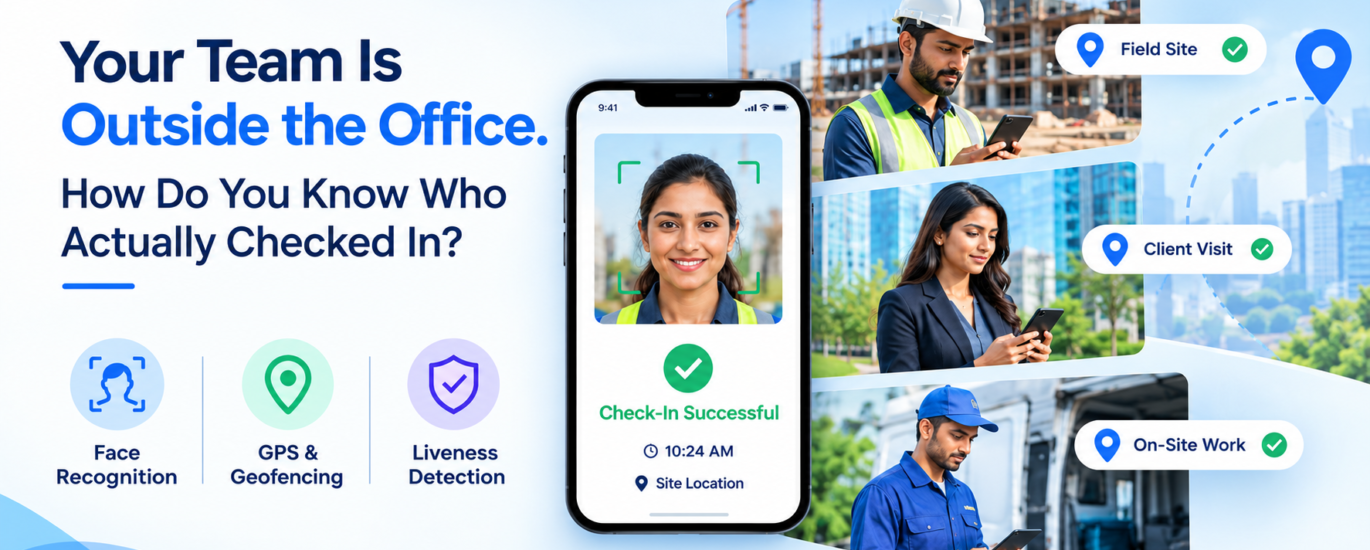
A modern attendance system can help businesses answer these questions by combining face recognition, location verification, and digital attendance records.
- Face Recognition for Employee Verification
Face recognition helps verify an employee’s identity during check-in, reducing dependence on manual attendance entries or another person marking attendance on their behalf.
With iLoggedIn, businesses can use face recognition-based attendance to make employee verification more convenient and systematic.
- GPS and Geofencing for Location Verification
Knowing who checked in is important. It can be just as useful to know where they checked in.
GPS-based location features and geofencing can help businesses define approved work locations and verify whether check-ins meet the configured location requirements.
This is especially useful for field employees, technicians, sales representatives, and teams working across multiple sites.
- Blink-Based Liveness Detection
Face verification should also consider whether the system is interacting with a live person rather than simply accepting a photograph.
iLoggedIn includes blink-based liveness detection, which adds a further verification step to its face recognition process. This helps strengthen the attendance verification process, although no single technology can eliminate every possibility of misuse.
- One System for a Distributed Workforce
Different employees may have different attendance requirements. Some report to the office, some work at customer locations, and others operate across several sites.
iLoggedIn supports attendance workflows for different working arrangements, including office-based, remote, and field teams. Configurable attendance modes can help businesses manage check-ins according to their operational needs.
Additionally, HR professionals may check attendance data and create reports more easily with digital records rather than relying solely on manual registers or dispersed communications.
How Verified Attendance Changes Daily Operations
Imagine a service company with employees visiting five different customer locations every morning.
Without a structured system, the HR manager may need to call each employee, collect updates, and manually reconcile attendance records.
With an appropriate face recognition and location-based attendance system, employees can record their check-ins digitally, while managers can review available attendance information from a central system.
Better insight into workforce attendance, less repetitive follow-ups, and a more organized approach are the outcomes.
It also gives managers more time to focus on work allocation, customer service, and team performance rather than spending the morning confirming who has arrived.
What Should Businesses Look for in an Attendance App?
Before choosing an employee attendance solution, consider whether it offers:
- Face recognition-based employee verification.
- GPS and geofencing capabilities where required.
- Support for multiple work locations.
- Flexible attendance options for office and field teams.
- Centralised attendance records and reports.
- Additional safeguards, such as liveness detection.
Businesses should also review device compatibility, privacy practices, access permissions, and how employee location information is collected and used.
The right system should make attendance easier to manage while maintaining transparency and respecting employee privacy.
Make Every Check-In More Meaningful with iLoggedIn
When your workforce operates beyond office walls, attendance management needs to evolve with it. A simple check-in message may tell you that an employee is working, but a well-designed verification process can provide more useful information about identity, time, and location.
iLoggedIn, an AI-powered face recognition attendance app by TechIndia Software, helps businesses simplify workforce attendance with face recognition, GPS-based location features, geofencing, and blink-based liveness detection.
Whether your employees work in the office, travel for client meetings, or operate across multiple sites, a more structured attendance process can help your organisation manage its workforce with greater clarity.
Explore iLoggedIn at https://www.iloggedin.com/ and discover a smarter approach to employee attendance management.